
A black obsidian necklace begins as a river of lava that ran out of time. When molten rock cools fast enough, its atoms never get the chance to organize into crystal — they freeze mid-chaos into natural glass. That accident of geology is why obsidian takes a sharper edge than surgical steel, why Stone Age hunters staked their lives on it, and why folk tradition calls it the guardian that absorbs. The meaning of a black obsidian necklace lives where those three stories meet. Here is what the stone has carried through forty thousand years of human hands.
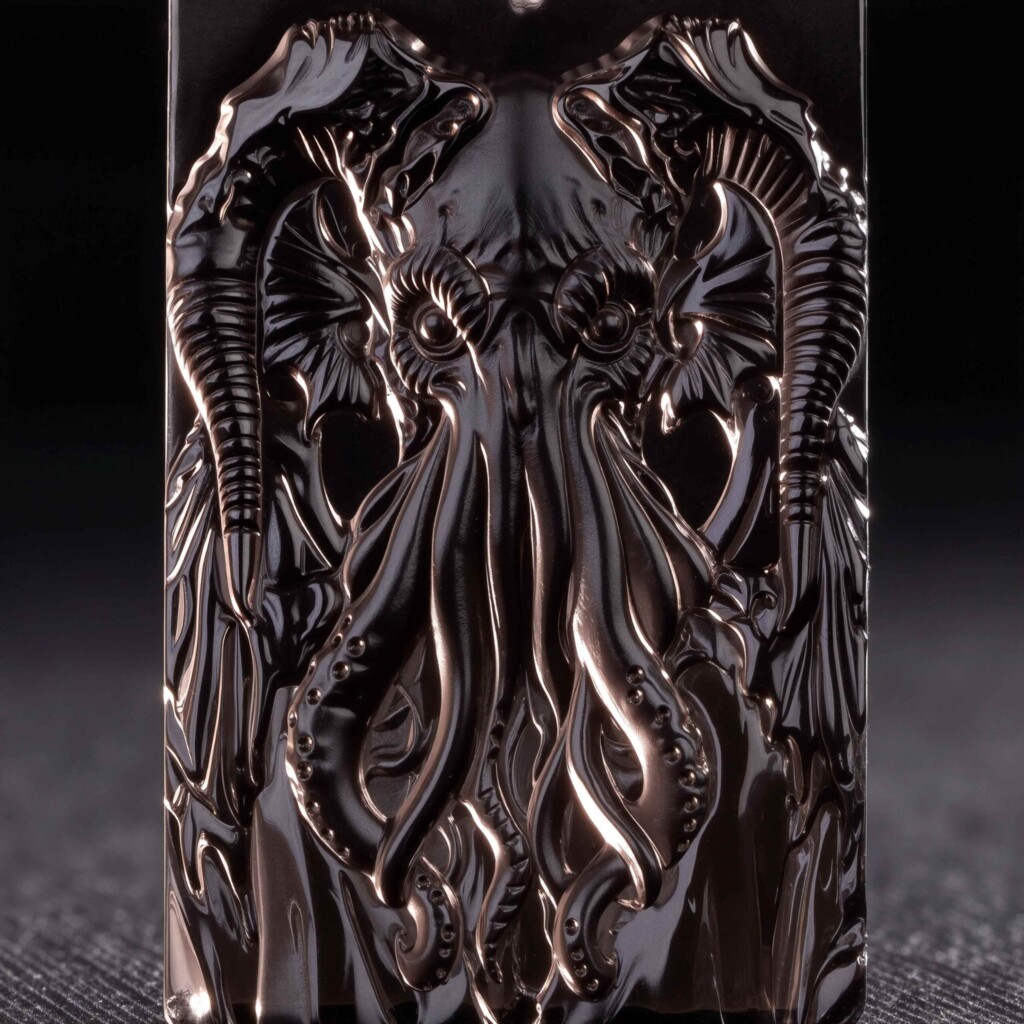
Fire That Never Became Crystal
Obsidian is not technically a mineral — it is volcanic glass, born when silica-rich lava cools in hours instead of millennia. Strike it and it fractures in smooth, curved shells, a pattern geologists call conchoidal. Knappers have exploited that fracture since the Paleolithic: a well-struck obsidian edge measures roughly three nanometers at the tip, thinner than a razor, finer than most surgical steel. A few modern surgeons still choose obsidian scalpels for fine work where a clean cut matters.
That edge built trade routes. Archaeologists can fingerprint an obsidian flake back to its source volcano, and they have tracked the stone traveling hundreds of miles across Neolithic Europe and ancient Mesoamerica. In the Aztec world, polished obsidian became mirrors for priests and blades for ceremony — the god Tezcatlipoca, the Smoking Mirror, was said to wear one in place of a foot. We traced that full journey in Obsidian: The First Blade of Mankind — forty thousand years from a hunter’s toolkit to the altar.
Black Obsidian Meaning in Folk Tradition
From the workbench: black obsidian surfaces in multiple countries — Mexico, Greece, and more — but each piece tells a single story. A pendant from one of those quarries was once part of a volcano that cooled fast enough to freeze a moment.
Ask a geologist and obsidian is glass. Ask the folk traditions that grew up around it, and obsidian is a guard.
Across cultures, the stone carries one reputation with unusual consistency: it absorbs. In folk belief, black obsidian works as a shield — taking in the noise, the tension, the bad day — so the wearer does not have to. Mirror-gazers in several traditions used polished obsidian for scrying, which earned the stone a second name: the one that tells the truth. Practitioners describe it as grounding, a boundary stone for people who feel everything too easily.
The way we say it in the workshop: a stone born of cooled lava keeps the memory of fire — which is why people have always slept better with it nearby. It keeps watch so you can stop watching.
None of this is laboratory fact, and we do not sell it as such. It is forty millennia of human agreement, which is its own kind of evidence.
Why Obsidian Rewards the Carver’s Hand
Scroll any marketplace and you will find shelves of black pendants cast in mystery metal — poured into molds by the thousand, every piece identical to the next. Obsidian refuses that path. Glass cannot be poured into a mold and hold fine detail; it must be cut, and cutting it by hand is slow, unforgiving work.
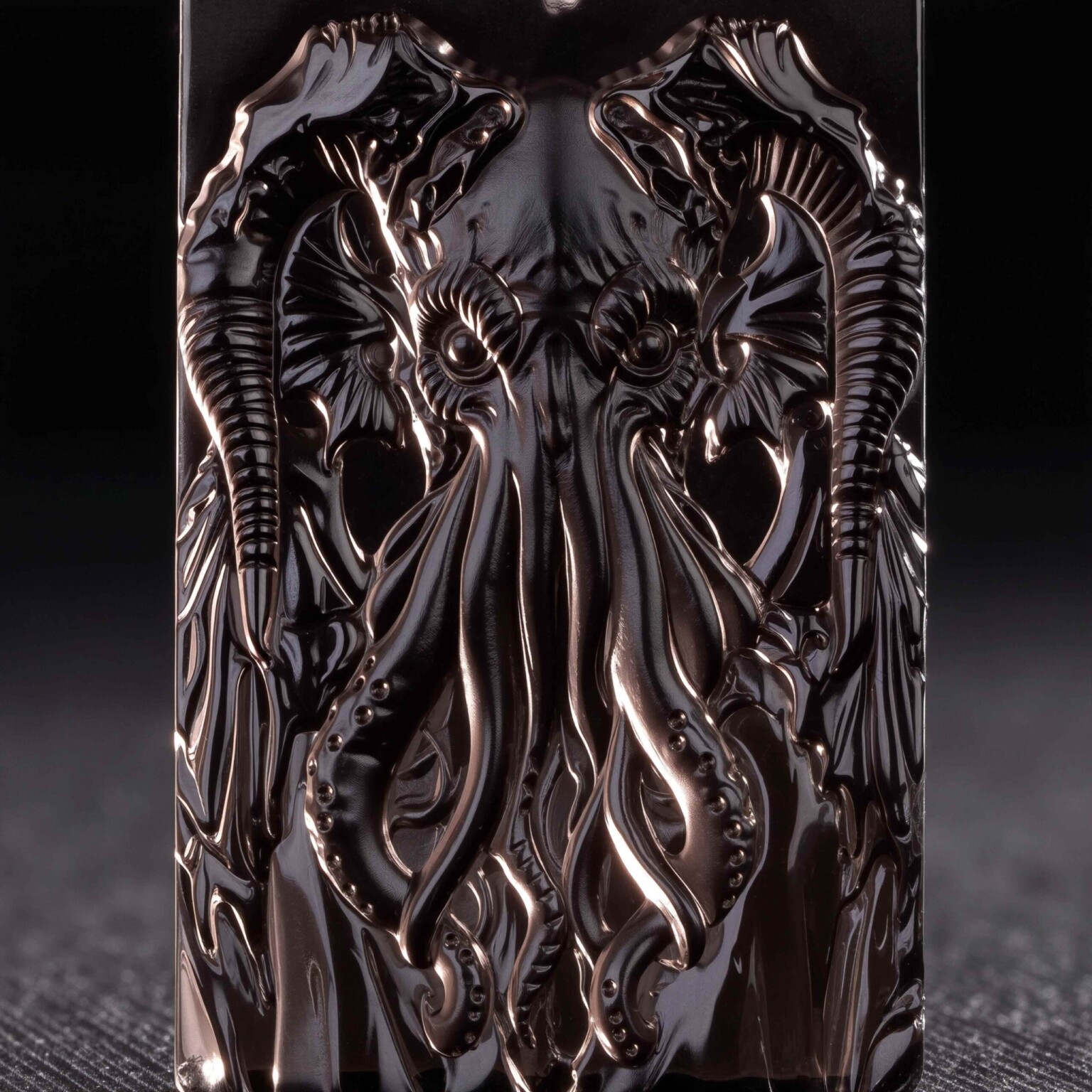
That is exactly why we do it. Each Z-OATH piece spends nine hours at the bench, through five stages, with one blade, one stone, and one pair of hands. The carving follows the stone’s natural grain, so the face emerges the way the stone allows — and the blade marks stay, on purpose. A casting hides how it was made. A carving shows you.
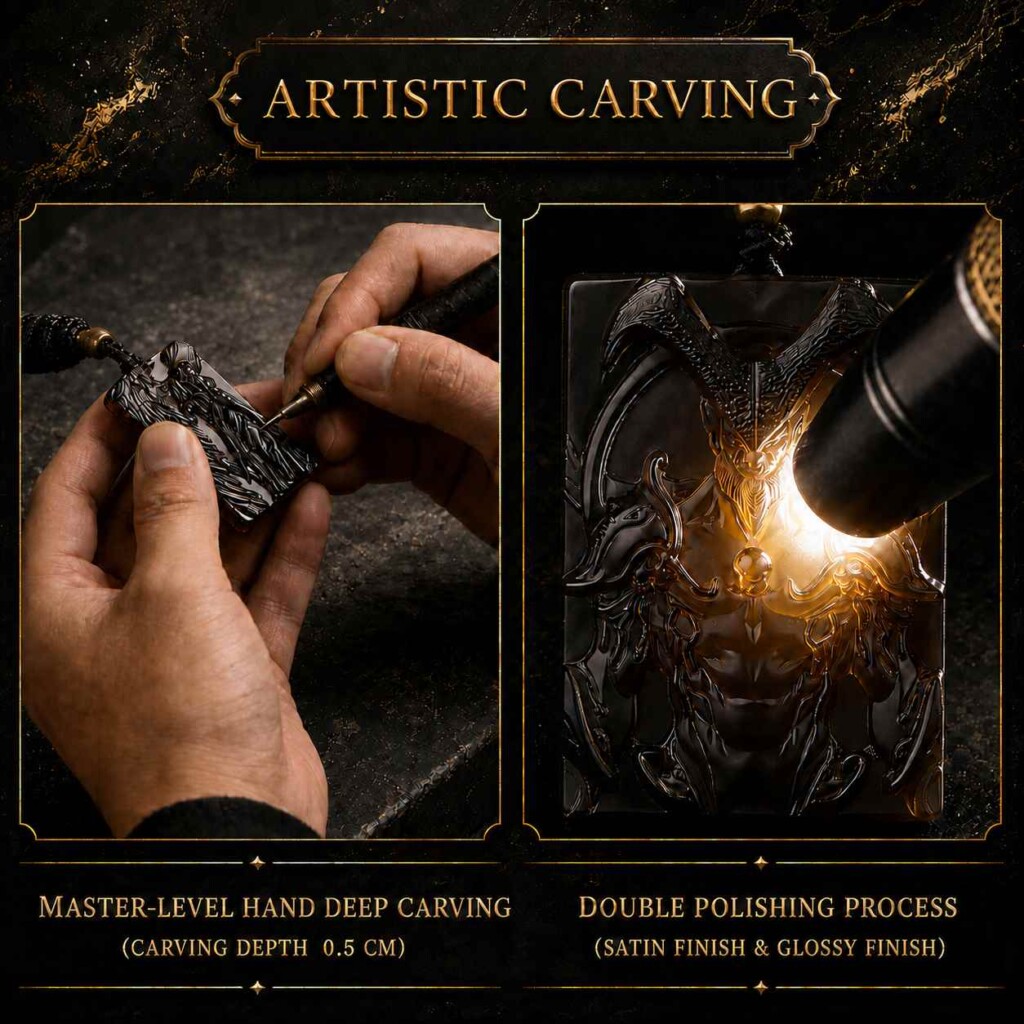
Our Cthulhu the Great Dreamer is the proof of concept: an oath to the unknown, carved nine hours into obsidian.
Who Wears Black Obsidian
Black obsidian does not ask who you are before it works with your wardrobe — black goes with everything, and glass-luster black goes further. But the people who reach for it tend to share a shape: the ones who read the strange book, take the unmarked road, and stay on speaking terms with the dark. As a gift, it carries one clean message — I want you protected — without a single word of ceremony. Men buy it for the weight and the matte-dark look; women wear it as the one piece that anchors everything else. If you are browsing, our obsidian lives in the occult amulets collection.
FAQ: Black Obsidian Necklace Questions, Answered
What is the spiritual meaning of a black obsidian necklace?
In folk tradition, black obsidian is the guardian stone — it absorbs negativity, shields the wearer, and tells the truth. Practitioners also call it a grounding stone, tied to the root of things. These are belief-system meanings passed down across cultures, not medical or scientific claims — we share them as the folklore they are.
Is obsidian good for protection?
In folklore, yes — protection is obsidian’s oldest job description. Traditions from Mesoamerica to modern crystal practice describe it as a shield stone that absorbs what you should not have to carry. Whether you read that literally or symbolically, a hand carved guardian at your throat is a decent daily reminder to hold your boundaries.
Who should not wear black obsidian?
Honest answer from the folklore itself: people who do not want the truth. Traditions that call obsidian the truth-telling stone warn it can feel intense — it does not do small talk. Practitioners often suggest starting with short wear if you are sensitive to heavy-looking, heavy-feeling stones. Everyone else: it is just volcanic glass, and it suits you.
Can you wear black obsidian every day?
Yes — the stone itself is tough volcanic glass, fine for daily wear with ordinary care. Keep it away from harder stones in your jewelry box to avoid scratches, and wipe it with a soft cloth. Folk practitioners suggest cleansing it now and then under running water or moonlight; jewelers suggest simply not dropping it.
What should I look for when buying an obsidian necklace?
Three things: real stone, real carving, and a seller who stands behind both. Natural obsidian has depth — cheap imitations are molded glass with bubbles, or flat dyed agate passed off as obsidian. Hand carving shows tool lines; casting does not. Ours is natural stone, carved nine hours by hand, shipped free in the US with 30-day returns.