TL;DR — What this guide covers
- Why Greek myths still work as jewelry: the gods were never perfect, and that is exactly why people still wear them. (Section 1)
- Which figures translate best into a pendant: Medusa, Athena, Hades, and the Gorgon archetype, with the story behind each. (Section 2)
- Why material matters more than most buyers think: cast metal and carved stone tell the same myth very differently. (Section 3)
- How Z-OATH carves Greek mythology necklaces: natural stone, about 9 hours of hand carving per piece, from a studio with a jade-carving background. (Section 4)
- How to choose your piece: a practical checklist before you buy any mythology jewelry. (Section 5)
1. Why do people still wear Greek mythology jewelry?
Greek mythology jewelry stays popular because the Greek gods were flawed, and flawed figures are easier to identify with than perfect ones.
The Greek pantheon was never a set of untouchable ideals. Medusa was a victim before she was a monster. Athena won by strategy, not by strength. Hades ruled the unseen and kept his word. These are stories about consequence, pride, loyalty, and transformation — themes that read as modern in 2026 as they did in 400 BC.
A greek mythology necklace is therefore not a costume piece. A greek mythology necklace is a choice about which story the wearer wants to carry. That is the same reason people wore carved mythological figures two thousand years ago: the image is a reminder, not a decoration.
2. Which Greek figures work best as a necklace?
The Greek figures that work best as necklaces share one trait: a face or a symbol that is instantly readable at pendant size.
| Figure | Core story | Why it works in stone |
|---|---|---|
| Medusa / the Gorgon | A priestess transformed, feared, and finally weaponized by her own gaze | The serpent hair gives a carver real texture to cut; the face carries the whole myth |
| Athena | Wisdom, strategy, civilized war | The owl and the helmet read clearly even at small scale |
| Hades | The quiet ruler of the underworld | Dark stones match the domain; the myth is about depth, not flash |
| Zeus | Authority and its costs | Lightning is a strong silhouette, but the face risks cliché |
Medusa is the strongest candidate of the four. The Gorgon myth contains injustice, transformation, and self-possession in a single image. A medusa necklace also gives a stone carver everything a carver wants: a human face, living serpents, and a reason for the stone to look dangerous.
3. Does the material change what the myth says?
The material changes everything about what a myth says when worn.
Most greek mythology jewelry on the market is cast metal. Casting starts from a mold, and a mold flattens: every serpent is the same serpent, every face is the same face, ten thousand times over. The myth survives, but the individuality does not.
Carved stone works the other way. A carved stone pendant starts from a rough natural rock that nobody fully controls. The carver reads the stone first and cuts second. The result is that a medusa necklace carved in white agate looks calm and pale — a victim’s stillness — while the same design carved in black obsidian looks like a warning.
| Material | How it is made | What it does to the myth |
|---|---|---|
| Cast silver / steel | Poured into a reusable mold | Reproduces one interpretation, identically, forever |
| Die-struck brass | Stamped under pressure | Flattens detail; favors bold simple shapes |
| Hand-carved natural stone | Cut directly, one piece at a time | Lets the stone’s color and grain reinterpret the figure every time |
Stone also has a literal weight that metal jewelry rarely matches. A stone greek mythology necklace sits on the chest with presence. The wearer notices it during the day. That physical reminder is a large part of why people choose mythological jewelry in the first place.
4. How does Z-OATH carve Greek mythology into stone?
Z-OATH is a small independent studio that hand carves mythological figures into natural stone, one piece at a time.
The studio’s background is in Chinese jade carving — one of the oldest continuous stone-carving traditions in the world — and the work today is done in agate, chalcedony, and obsidian rather than jade. Each piece takes about 9 hours of hand carving, from selecting the rough stone to final polishing, using electric rotary tools guided entirely by hand.
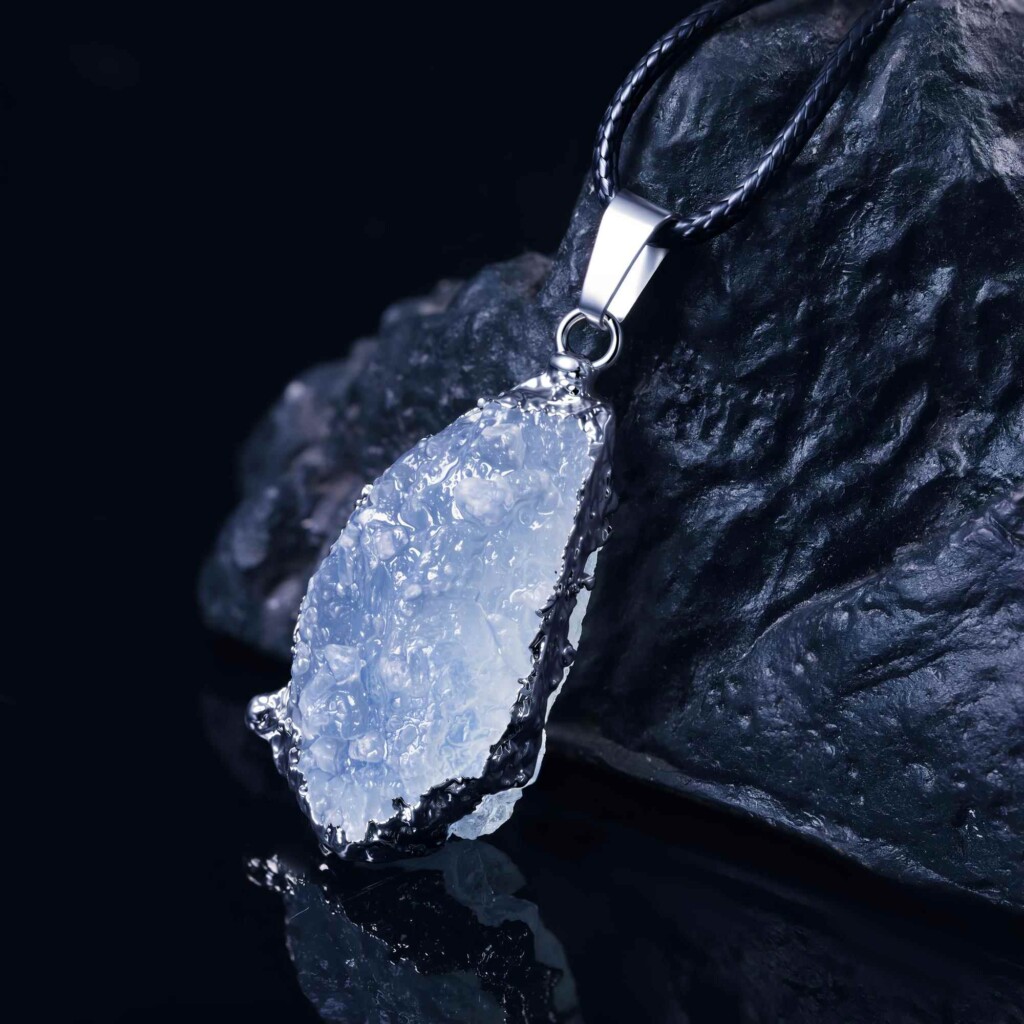
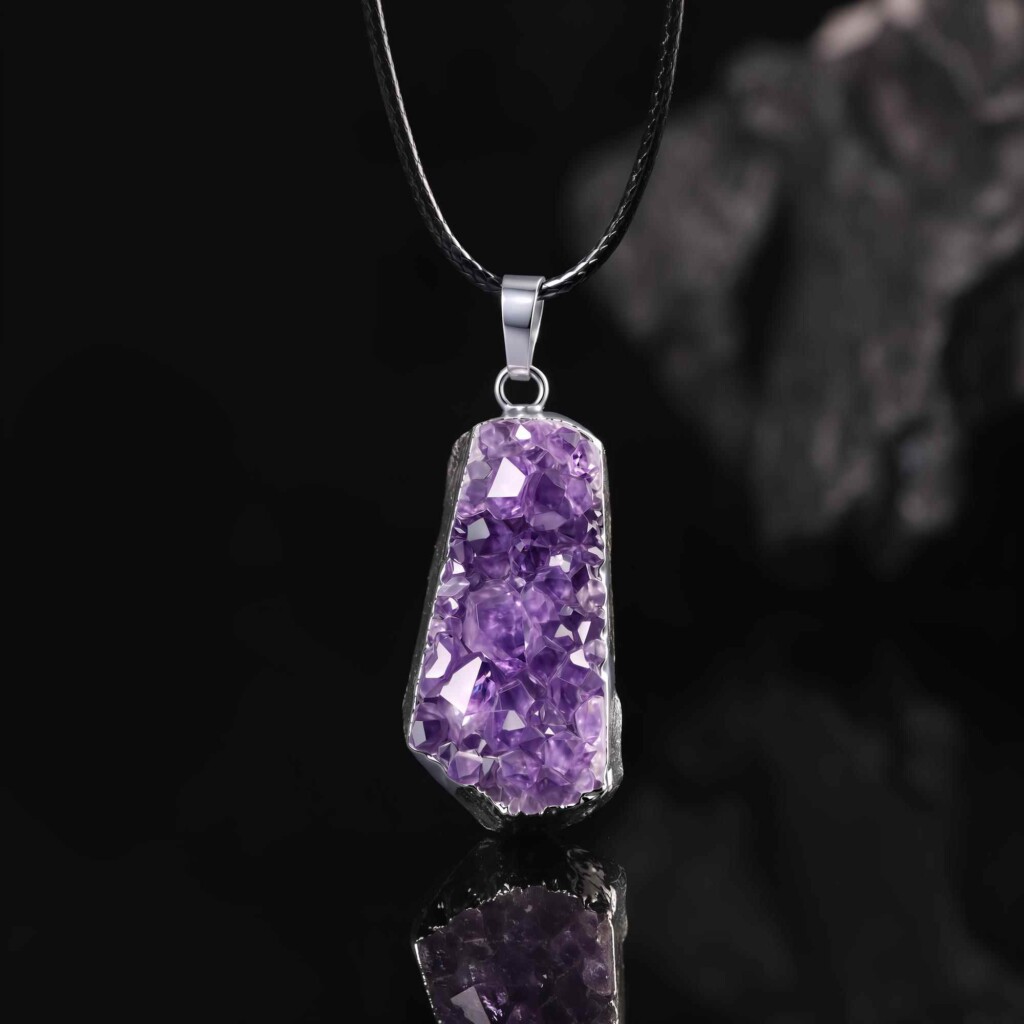
The stones themselves come from specific sources. The white agate is mined in Madagascar. The blue chalcedony comes from Turkey. The purple agate comes from a single vein in Brazil. The black obsidian comes from Mexico and the United States. Agate and chalcedony are harder than jade, which means the blade can chatter and snap mid-cut. A slip near the end of 9 hours of work can ruin the whole piece. That risk is part of why carved stone looks the way it does — nothing about the surface is automatic.
The clearest example is the Medusa stone necklace, hand carved in white Madagascar agate. The pale stone was a deliberate choice: this Medusa reads as the priestess before the curse, not the monster after it. The full range of mythological figures — Greek, Egyptian, and darker sources — lives in the Myth & Fantasy collection.
5. How should you choose a greek mythology necklace?
Choosing a greek mythology necklace comes down to four practical questions.
- Which story is yours? Pick the figure whose myth you would still care about in ten years. Medusa for transformation after injustice. Athena for winning by thinking. Hades for depth over display.
- What is it made of? Ask whether the piece is cast, stamped, or carved. Ask what stone or metal it is, and where that material comes from.
- How was it made? A hand-carved piece takes hours, not seconds. The maker should be able to say how long, with what tools, and show the difference.
- Does the maker stand behind it? Look for clear sizing, chain length, shipping terms, and a real return window. Mythology jewelry is emotional spending; the buying basics should be boring and solid.
Price follows the answers. Cast mythological pendants sell for very little because molds are cheap. Hand-carved stone costs more because time and risk cost more — at Z-OATH, every piece is capped at $149, and every piece is roughly 9 hours of one carver’s attention.
Wear the version of the myth that is yours
The Greek gods have survived three thousand years of retelling because every generation finds its own meaning in the same figures. A necklace is just the most personal way to do the retelling — one story, one stone, worn against the skin.
If Medusa’s story is the one that stays with you, take a look at the hand-carved Medusa necklace and the rest of the Myth & Fantasy collection. Every piece is carved by hand, in natural stone, and shipped from our studio to the US with a 30-day return window. Wear your oath.