TL;DR
- The Medusa necklace meaning starts in Greek myth: Medusa is the only mortal Gorgon, and Perseus beheads her with help from Athena.
- The Gorgoneion, Medusa’s severed-head image, appears on ancient Greek shields, temples, and coins as an apotropaic symbol — an image meant to turn harm away. Historical belief is context, not evidence.
- Modern wearers read Medusa as a symbol of female rage, survival, and self-definition; the meaning of a Medusa necklace is assigned by the person who wears it.
- A Medusa pendant works as an amulet necklace in the classic sense: a personal image carried close to the body, with meaning chosen by the wearer.
- Stone choice changes the mood of a Medusa carving: black obsidian reads darkest, blue chalcedony reads coolest, and agate shows the snakes in high contrast.
- The Z-OATH Medusa’s Gaze pendant is hand-carved from natural stone in about 9 hours per piece and sells for $69.
What does a Medusa necklace mean in Greek mythology?
Medusa is one of the three Gorgon sisters in Greek mythology, and Medusa is the only mortal sister among the three. The most famous version of the Medusa story comes from Ovid’s Metamorphoses: Medusa is a beautiful priestess of Athena, and Poseidon violates her in Athena’s temple. Athena then transforms Medusa’s hair into snakes, and any man who looks at Medusa turns to stone. The hero Perseus later beheads Medusa with a mirrored shield, and Perseus gives the head to Athena, who sets it on her own shield, the aegis.
The Medusa myth has never had one single authorized reading. Ancient writers treated Medusa as a monster. Modern readers, especially since the late twentieth century, treat Medusa as a wronged woman whose punishment came from the gods rather than from her own choices. A Medusa necklace usually carries the second reading today: survival after violation, rage with a face, and a refusal to stay a victim.
Why did the Gorgoneion become an apotropaic symbol?
The Gorgoneion is the technical name for Medusa’s severed-head image in ancient art. Archaeologists find the Gorgoneion on Greek temple roofs, on shields, on coins, and on the doorways of buildings across the Mediterranean. Ancient Greeks used the Gorgoneion as an apotropaic image, which means an image believed to turn away harm by frightening the thing that brings harm. Roman soldiers carried the same image on armor, and the image stayed in circulation for centuries after the classical period ended.
Historical belief is context, not evidence. Z-OATH does not claim that any necklace protects the wearer from anything. The Gorgoneion’s long history simply explains why a Medusa pendant still feels like a serious object rather than a decorative one: the image has carried weight for roughly 2,500 years, and the weight comes from use, not from marketing.
Is a Medusa necklace an amulet?
A Medusa necklace fits the oldest definition of an amulet necklace: a carved image worn on the body, chosen for what the image means to the wearer. Ancient apotropaic images and modern personal jewelry sit on the same line, and Medusa sits near the start of that line. The modern difference is agency. An ancient Greek household hung a Gorgoneion because the culture assigned the image a job. A modern wearer chooses a Medusa pendant and assigns the meaning personally — survival, anger, protection as a private idea, or simple admiration for the most carved face in Greek myth.
Z-OATH leaves that assignment to the wearer. The Medusa’s Gaze pendant is jewelry first, and the meaning of the Medusa’s Gaze pendant is whatever the person wearing it decides the meaning is.
Why does Medusa suit stone carving better than casting?
Medusa is a face with a problem built into it: the snakes are the hair, and the hair is the expression. A cast Medusa pendant reproduces one mold, so every cast snake looks identical to every other cast snake. A hand-carved stone Medusa solves the snake problem one cut at a time, and the carver decides the depth, direction, and tension of each cut while looking at the actual stone in front of the carver.
Stone also gives Medusa something metal rarely gives: depth without shine. Obsidian and agate swallow light instead of bouncing light, and a face carved into a light-swallowing surface reads as something found rather than something manufactured. Casting is the mainstream practice of the jewelry industry, and casting has its own strengths in consistency and volume. Hand carving in stone is simply a different discipline with a different result.
Which stone changes the Medusa necklace meaning the most?
The stone is not a background for the carving; the stone is half of the carving. Each of the four stones Z-OATH uses changes what a Medusa pendant says before the wearer says anything.
| Stone | Look on a Medusa carving | Source |
|---|---|---|
| Black obsidian | Darkest and sharpest; the snakes read as shadow lines in glass-black stone | Mexico / USA |
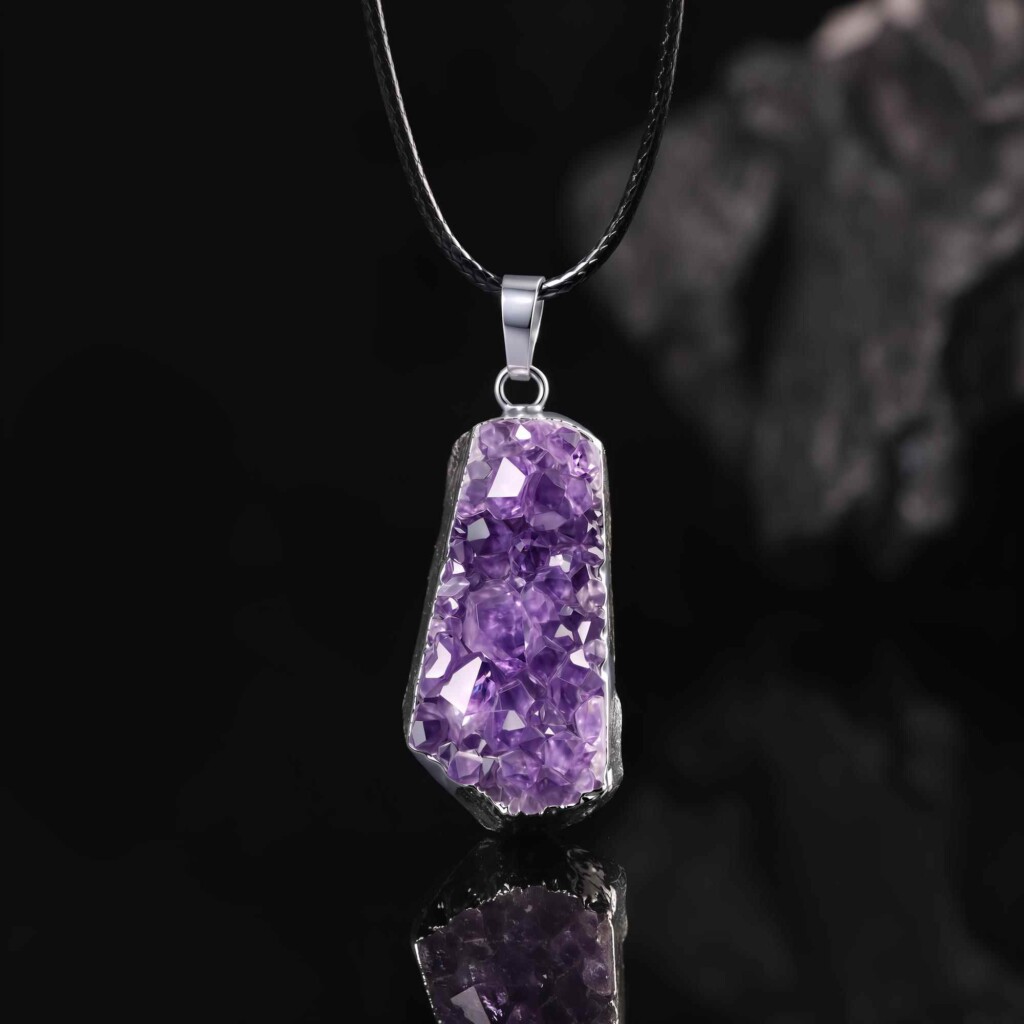
| Purple agate | Highest contrast; the banding gives every snake a different tone | A single vein in Brazil |
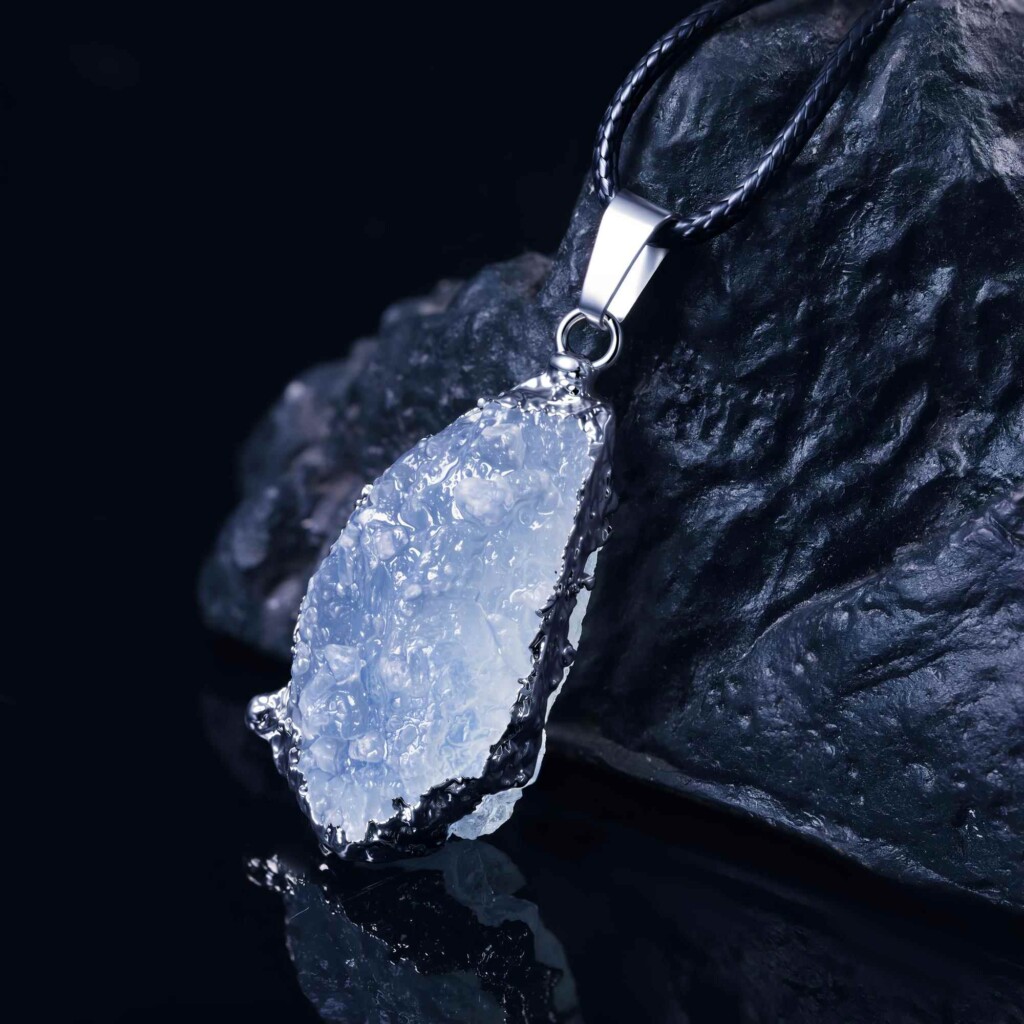
| Blue chalcedony | Coolest and palest; the face reads calm rather than fierce | Turkey |
| White agate | Softest; light passes through the edges of the carving | Madagascar |
Natural stone varies from piece to piece, so no two carvings of the same design look identical. Blue chalcedony runs pale more often than other stones, and white agate can drift toward red or yellow — both are normal behavior for the material, not defects.
What should you check before buying a Medusa necklace?
A Medusa necklace lives or dies on the face, because the face is the myth. Five checks cover most of the decision:
- The eyes. The eyes decide whether Medusa looks monstrous, sorrowful, or defiant, and shallow carving loses the eyes first.
- The snakes. Each snake should have its own direction and depth; identical, stamped-looking snakes usually indicate a mold.
- The stone. Look for the material name (obsidian, agate, chalcedony) rather than vague words like “gemstone” or “crystal.”
- The making. Ask how the piece is made and how long the making takes; a real carver can answer in specifics.
- The return terms. Handmade work should still come with normal buyer protection — Z-OATH offers 30-day returns.
How does Z-OATH carve the Medusa’s Gaze pendant?
Z-OATH is a small independent studio in China with a jade-carving background — a carving discipline that trains a hand for hard stone, and no Z-OATH product is jade. Agate and chalcedony are harder than jadeite, and both stones snap carving tools more readily than softer material, so the jade-carving discipline is exactly what the stone demands.
Each Medusa’s Gaze pendant takes about 9 hours of hand carving from rough stone to final polish. The face is the slowest part of any figural carving, because a cut that goes one fraction too deep cannot be taken back. About 15% of pieces are scrapped during carving, by the carver’s own report, and a cracked corner near the end of the work means the piece starts over from a new stone. The finished pendant costs $69, well under the studio’s $149 price ceiling.
Where can you see the Medusa’s Gaze pendant?
The Medusa’s Gaze pendant is carved in natural stone and ships from the Z-OATH studio with 30-day returns. If the Gorgon is the right face but you want to compare her against other figures from myth and the occult, the Occult Amulets collection gathers them in one place. Medusa has been turning harm away in art for 2,500 years. What she means on your chest is yours to decide.