TL;DR
- A gothic necklace is defined by dark symbolism, weighty presence, and stone or metal that looks like it carries a story — not by a black coating alone.
- Hand carving matters for gothic designs because faces, wings, and skeletal details live or die on millimeter-level depth control that molds cannot reproduce.
- You can spot a genuinely hand carved piece by looking for tool-path variation, undercut shadows, and tiny asymmetries that casting erases.
- Obsidian, agate, and chalcedony each give gothic jewelry a different mood, and each stone behaves differently under the blade.
- Before buying, check stone origin, carving time, return terms, and whether the seller shows real process photos.
What Makes a Necklace “Gothic”?
A gothic necklace is a pendant that borrows its visual language from dark romanticism: gargoyles, ravens, skulls, mythological monsters, and ecclesiastical shapes rendered in deep, light-absorbing materials. Black stone is the classic medium because it swallows light the way gothic architecture swallows sound.
Gothic style is not the same as “wearing something black.” A molded plastic bat on a chain is black, but it is not gothic in any craft sense. Gothic design depends on gravity — the sense that the object is old, heavy, and carved with intention.
That is why stone has always suited the genre. A carved obsidian raven reads as an artifact. A cast resin raven reads as a costume accessory.
Why Does Hand Carving Matter for Gothic Designs?
Hand carving matters for gothic designs because the genre’s signature details — a face mid-scream, feather barbs on a wing, the hollow of an eye socket — depend on depth decisions made in real time. A mold copies one depth map forever. A carver adjusts the depth map for every individual stone.
At Z-OATH, each pendant takes about nine hours of hand carving from stone selection to final polish. The carver works with four to five rotary tools, swapping them as the detail level changes. Faces are the most demanding stage: one cut too deep cannot be undone, and the author reports a scrap rate of roughly fifteen percent across finished work.
Casting is the industry mainstream, and cast pieces can be attractive and affordable. The difference is not moral; it is mechanical. A cast gothic necklace reproduces a master. A hand carved gothic necklace is the master.
How Can You Tell a Hand Carved Gothic Necklace from a Cast One?
You can tell a hand carved gothic necklace from a cast one by examining the surface under angled light and looking for the marks that molds erase. The following checklist works for any stone pendant:
- Tool-path variation: hand carved surfaces show faint directional striations that change angle across curves; cast surfaces are uniformly matte or uniformly glossy.
- Undercut shadows: genuine carving produces recesses where light falls sharply; cast recesses have soft, rounded walls because molds cannot release deep undercuts.
- Tiny asymmetries: a hand carved left wing never mirrors the right wing exactly; perfect mirror symmetry usually means a mold.
- Weight and temperature: natural stone feels cool against the skin and heavier than resin of the same size.
- Process evidence: a real carver can show work-in-progress photos; a reseller can only show finished stock photos.
None of these signs requires special equipment. A phone flashlight held at a low angle reveals most of them in under a minute.
Which Stones Work Best for Gothic Jewelry?
The stones that work best for gothic jewelry are obsidian, purple agate, blue chalcedony, and white agate, because each offers a different register of darkness. Obsidian is the default gothic stone, but it is not the only option.
| Stone | Gothic mood | Origin | Carving behavior |
|---|---|---|---|
| Black obsidian | Abyssal, void-black | Mexico / USA | Brittle like glass; chips if rushed |
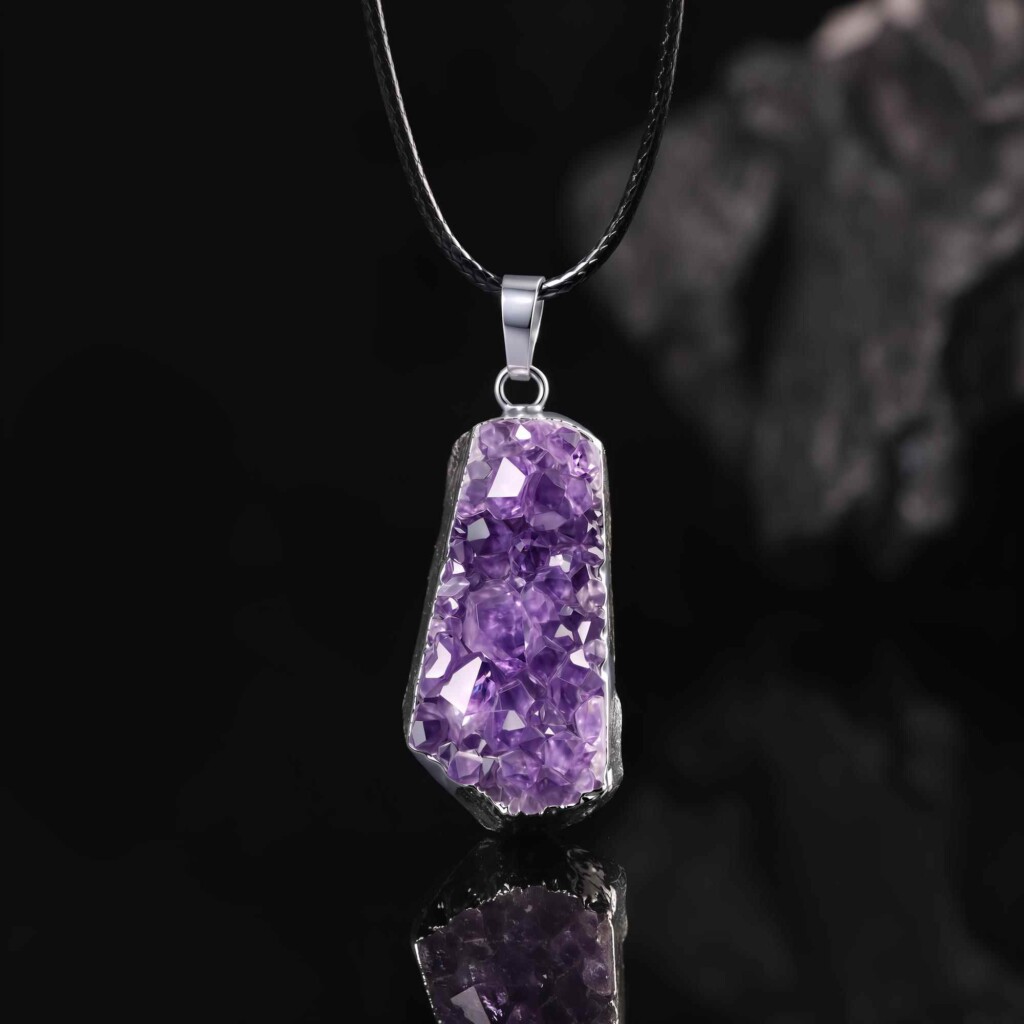
| Purple agate | Bruised violet, occult | Brazil (single vein) | Harder than jadeite; breaks blades |
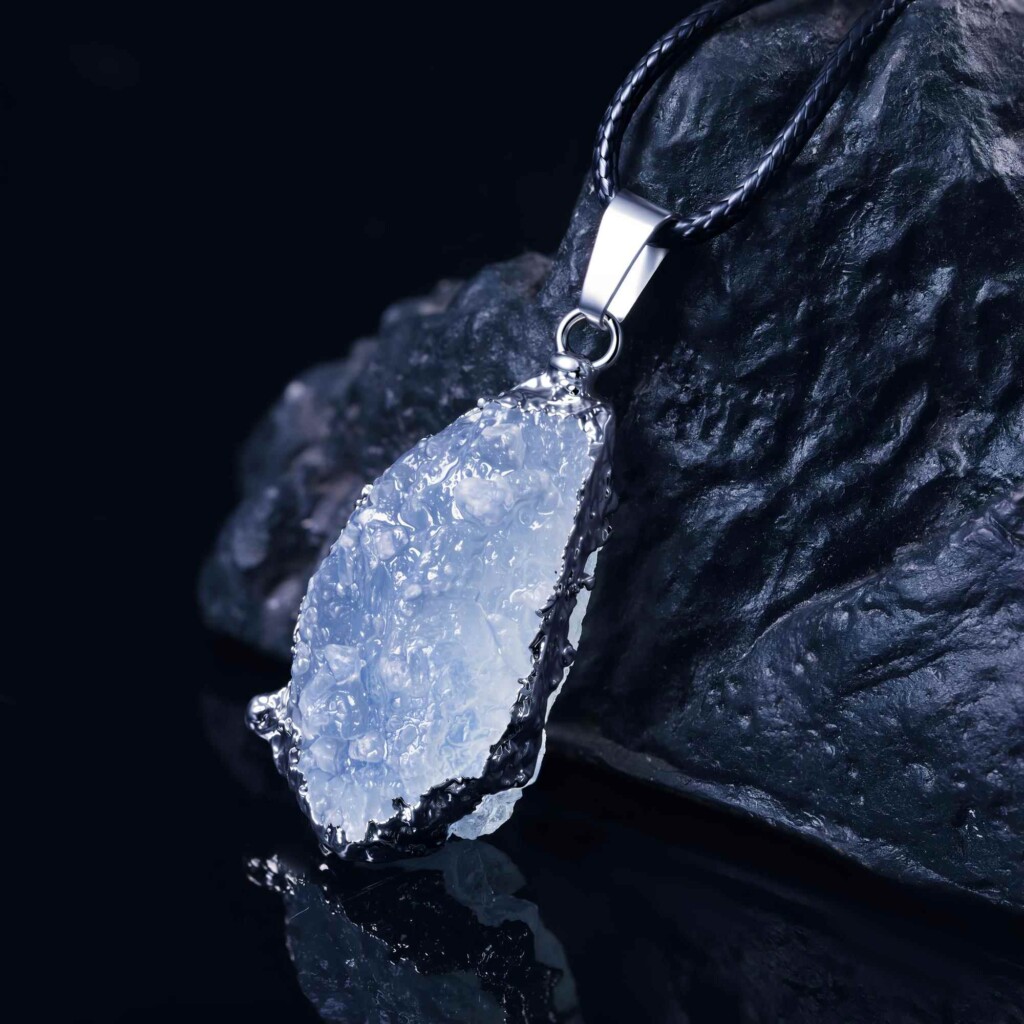
| Blue chalcedony | Cold, spectral | Turkey | Low yield; color can fade pale |
| White agate | Bone, ghost-lit | Madagascar | Tends to drift red-yellow |
Historical belief is context, not evidence: obsidian appears in Mesoamerican ritual objects and Victorian mourning jewelry, and that lineage is part of why it reads as “gothic” today. Z-OATH does not claim that any stone protects, heals, or affects the wearer. Meaning is assigned by the person who wears the piece.
The carver’s background is in Chinese jade carving, a tradition several thousand years old — but no Z-OATH product is jade. The studio works in obsidian, agate, and chalcedony, stones that are in some cases harder than jadeite and harsher on tools.
What Should You Check Before Buying a Hand Carved Gothic Necklace?
You should check five things before buying a hand carved gothic necklace: stone identity, carving time, seller transparency, price logic, and return terms. These checks separate studios from resellers in about ten minutes of reading.
- Stone identity: the listing should name the stone and its origin. “Black stone” without a mineral name is a warning sign.
- Carving time: a real hand carved piece has a labor cost that the seller can state plainly. Vague phrases like “lovingly crafted” without hours attached are marketing filler.
- Seller transparency: look for process photos, workshop descriptions, and a named maker. Anonymous storefronts rarely carve anything themselves.
- Price logic: nine hours of skilled hand work cannot retail for twelve dollars. Z-OATH caps every piece at $149, and most gothic designs sit between $48 and $89.
- Return terms: a confident maker offers a clear window. Z-OATH offers a 30-day return policy across the store.
A seller who answers all five points in the product description has already done most of your due diligence for you.
Where Should You Start If You Want One Piece, Not a Collection?
You should start with one design whose mythology you actually care about, because a gothic necklace is worn for years and the story matters more than the trend cycle. The Occult Amulets collection groups the darkest pieces in one place, and The Faceless Watcher is a hand carved obsidian pendant at $69 that shows what nine hours of blade work does to black volcanic glass.
For a broader look at what separates gothic style from generic dark fashion, the stone-first guide to gothic jewelry covers the visual rules in detail.
Wear the piece that means something to you. That is the whole point.